
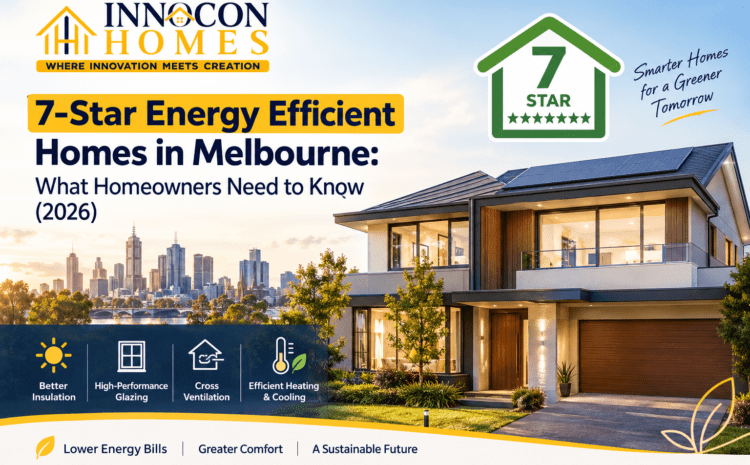
7-Star Energy Efficient Homes in Melbourne: What Homeowners Need to Know (2026)
If you’re planning to build a new home in Melbourne, you’ve likely heard the term “7-star energy rating” thrown around by builders and designers. But what does it actually mean for your budget and your future comfort?
What Is the 7-Star Energy Standard?
The National Construction Code (NCC 2022) raised the minimum energy efficiency requirement for new homes from 6 stars to 7 stars under the Nationwide House Energy Rating Scheme (NatHERS). Victoria adopted this change in 2024, which means every new home built today in Melbourne must meet this benchmark before receiving a building permit.
Think of it like a fuel-efficiency rating — but for your house. In Melbourne’s four-seasons-in-a-day climate, the difference is no small thing.
What Actually Changes in a 7-Star Home?
A 7-star home isn’t about one big upgrade — it’s a series of smart, interconnected decisions made during the design phase. Here are the key areas that typically get attention:
Orientation and window placement. In Melbourne, living areas facing north capture winter sun while minimising harsh summer heat. Large west-facing windows without shading are one of the biggest reasons homes fail their ratings.
Insulation. Higher R-values in ceilings, walls, and floors keep warmth in during winter and out during summer.
Glazing. Double glazing is increasingly standard, and window frames, seals, and external shading devices all contribute to the rating.
Cross-ventilation. Good airflow design can dramatically reduce reliance on air conditioning in summer.
Efficient heating and cooling. Heat pumps and zoned systems outperform old-school ducted gas heating. And even if you don’t install solar immediately, a 7-star home is designed so panels can be added easily later.
Does a 7-Star Home Cost More to Build?
Honestly — yes, slightly upfront. Better glazing, more insulation, and smarter design details do add to the initial cost. Most industry estimates put it in the low single-digit percentage range of a total build cost.
Wondering how energy upgrades fit into your overall budget? Read our breakdown of the real cost of building a house in Melbourne. For a statewide view, check out our guide on the cost of building a home in Victoria.
But here’s what matters: that extra cost typically pays itself back through lower energy bills. A 7-star home can use significantly less energy for heating and cooling than an older 5 or 6-star equivalent — and that saving compounds every year you live there.
Plus, energy prices aren’t going down. Building to a higher standard today is essentially locking in protection against tomorrow’s bills.
The Comfort Factor Nobody Talks About
Money aside, the difference you feel living in a 7-star home is real. Rooms hold their temperature. Cold spots near windows disappear. The house stays cooler on 35-degree days without the air conditioner running constantly. It’s the kind of quality-of-life upgrade that’s hard to appreciate on paper but impossible to ignore in winter.
Common Mistakes to Avoid
Treating the rating as an afterthought. Energy efficiency is designed in, not bolted on. Retrofitting is always more expensive than getting it right at the drawing board.
Choosing a builder without NatHERS experience. Every 7-star home starts with the right custom home builder in Melbourne who works with an accredited energy assessor from the early design stages — not one who scrambles to pass the rating at the end.
Ignoring your block’s potential. If your current home is too old or inefficient to retrofit, a knockdown rebuild often makes more sense than trying to patch up a 5-star relic.
Forgetting about multi-dwellings. For investors and families developing dual occupancy homes, energy compliance works a little differently — each dwelling needs to be assessed individually.
Choosing between renovate or rebuild blindly. If you’re torn between updating your existing place or starting fresh, our Melbourne home extensions trends for 2025 post is worth a read before you decide.
Focusing only on the rating, not the outcome. A 7-star rating on paper means little if the home has poor airflow, dark rooms, or impractical layouts. The best energy-efficient homes combine compliance with genuinely liveable design.
How Innocon Homes Approaches Energy-Efficient Building
At Innocon Homes, energy efficiency is baked into our design process from day one — not treated as a compliance hurdle. Whether you’re building a custom home, knocking down and rebuilding, or developing a dual occupancy, we work with accredited assessors early to ensure your home not only meets the 7-star standard but does so in a way that enhances comfort, livability, and long-term value.
Because at the end of the day, a star rating is just a number. A warm winter morning without a hefty gas bill? That’s the real goal.
Get in touch with our team to discuss your block, your budget, and how a 7-star home could work for you.